

In 1861, as soon as the kingdom of Italy was born, the first National Exposition was held in Florence, followed by that of Milan in 1881 and Turin in 1884. In Palermo the National Exposition was held from November 15, 1891 to June 5, 1892. the exposition of Palermo represented an important showcase of the state of Sicily from the point of view of its cultural, social and economic development. A relevant role was played by the stands dedicated to the restoration work already carried out in Sicily, those of art contemporary art, agriculture, Sicilian handicrafts and industry in relation also with exhibitors from the rest of Italy. An important sector of the Palermo exposition was represented by agriculture and thus oenology.
At the exposition, just to mention a few places located east of the city of Palermo, along with wines produced from the grapes of the contrada Corvo di Casteldaccia, of Duke Enrico Alliata di Salaparuta, there were also wines produced in the Bagheria lands of Benso duke of Verdura, of the marquise of Mortillaro and those produced in Santa Flavia by Giorgio Maggiacomo and in S.Onofrio (Altavilla Milicia) by the Marquis of Collalto.
Enrico Alliata’s Corvo wine participated out of competition being the nobleman, president of the oenological ordering commission of the Palermitan exposition, nevertheless the Corvo white, red and dessert wines were a huge success. In fact, so expressed the contemporaries, “The wines of the Duke of Salaparuta presents a battalion of bottles of his Cordo wine, which is set to become famous and not only in Italy.”
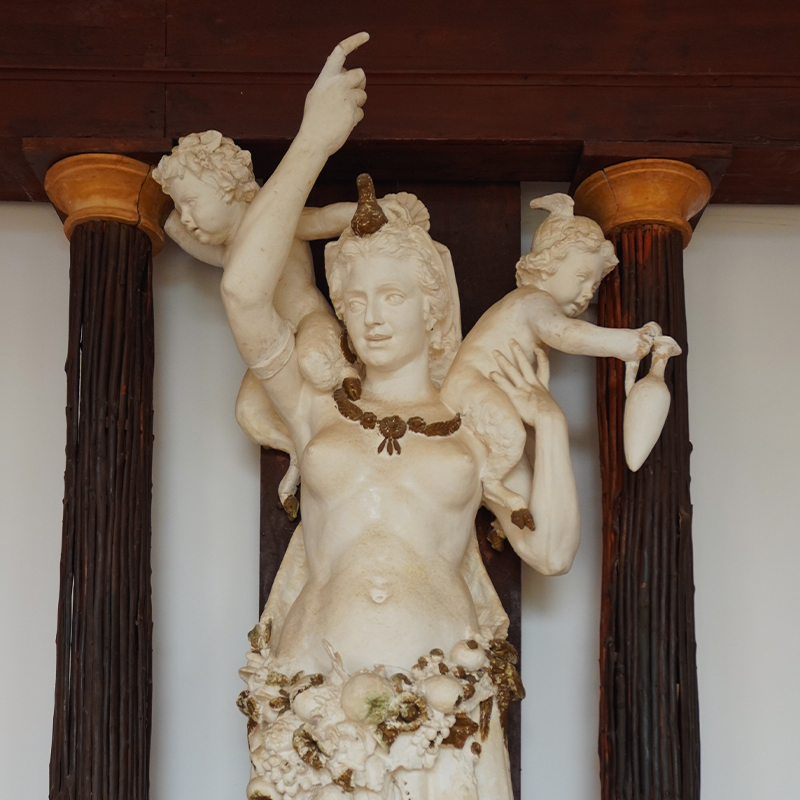
The Corvo wines stand was created by Mario Rutelli (1859-1941) at the behest of Enrico Alliata. From a photo published in the Revue universelle of May 1901, we read in full the original composition that in the setting of a Doric temple, advertises the “White” and “Red” of the Vini Corvo in the triglyphs and metopes of the entablature. Missing are the pictorial elements, made on the back of the counters for the tasting and, the golden eagle, emblem of Palermo, placed in the tympanum.
Also present at the Palermo exhibition were works made by master stone mason Nicolò Rutelli (1857-1923), Mario’s brother. Rutelli’s sculptor for the art exhibition contemporary art set up in one of the sections of the exhibition presented a bust in bronze, life-size, of Prince Enrico Alliata himself. The painter Onofrio Tomaselli, a native of Bagheria, for the contemporary art exhibition of the 1891 exhibition presented two works, “Loves and Kisses” and “A First Crime.”
Bagheria, in addition to the wine houses, was present at the Palermo exposition with canned products (a real novelty at the time) such as legumes and vegetables preserved by Tommaso Arena, tomato preserves and legumes and vegetables preserved by the firm of Dragotta and Ferrante, tomato sauce from the firm of Giuseppe Verdone and the firm of Fricano brothers, and preserved legumes and vegetables from the firm of Nicosia and Scaduto, the latter existing just inside Villa Cattolica.


